
We Reduce Uncertainty Before It Reaches Your Practice.
Satori is an operational intelligence layer for pediatric care—turning environmental conditions
into early, calm guidance so demand becomes more predictable without adding workflow.

Respiratory demand doesn't overwhelm
practices because of volume.
It overwhelms them because it arrives unevenly—building quietly, then clustering all at once, out of sync with when families can act and clinics can absorb it.
The five ways respiratory
demand turns into operational chaos.

Demand spikes you can’t staff for

After-hours spillover that never stops

Anxiety turns questions into emergencies

Trust erodes when families feel blindsided

The quiet burden of preventability
Meet

Satori makes invisible environmental risk visible early—so uncertainty
is resolved before it becomes demand, and operations stay predictable.
How Satori Works at Its Core
Satori is a continuous operational intelligence system that anticipates environmental risk, resolves uncertainty in real time, and reinforces understanding—so demand arrives earlier, calmer, and more evenly across your practice.
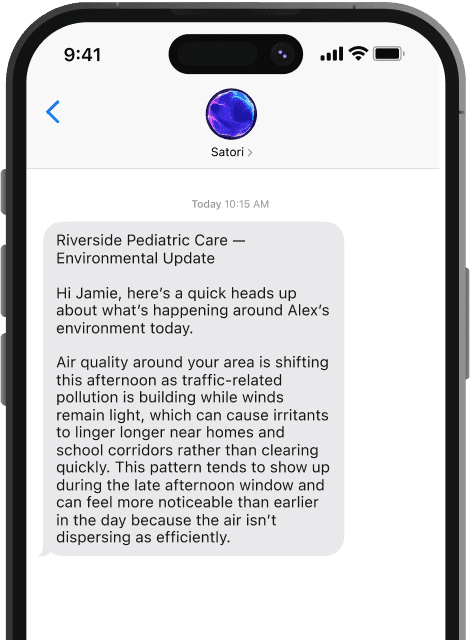
Hyper-Local, Child-Centric Monitoring
Satori monitors environmental conditions at the level of a child’s immediate neighborhood—roughly a city block—and interprets them through that child’s sensitivities, so risk is identified early, before it reaches families or your practice.
How Satori Changes the Way Demand
Enters Your System

Earlier Visibility Changes Load

Fewer Situations Reach After-Hours

Uncertainty Stops Driving Inbound Demand

Care Feels Anticipatory, Not Reactive

Visibility Relieves the Invisible Weight
What Your Families Will Experience

Anticipation
Satori identifies rising environmental risk before symptoms appear, allowing families to adjust calmly and early—so awareness arrives before worry, and worry never has time to become panic.
Why Satori Intelligence Works

Because it’s built on pediatric physiology and exposure science — modeling how children actually
respond to environmental conditions, not how air quality is generically scored.
Risk Builds Before Symptoms Appear
Respiratory stress builds over time, not all at once. By the time symptoms appear, the process is already underway—so meaningful prevention depends on seeing conditions before clinical signs surface.
Children React Earlier Than Adults
Children are more sensitive to environmental stress, so meaningful risk emerges earlier than adult-based thresholds suggest. Public air scores reflect population averages—not pediatric vulnerability.
Timing Predicts Disruption More Than Severity
Impact is shaped by when exposure occurs, not just how severe it is. Moderate conditions during sensitive windows often drive more disruption than extreme conditions at quieter times.
Calm Guidance Prevents Escalation
Most escalation is driven by uncertainty, not severity. When families receive clear context early, fewer situations turn into urgent calls, visits, or after-hours demand.
Designed to Add Protection—Not Work
Satori operates autonomously—handling monitoring, interpretation, and communication end-to-end so your team never has to.

No Monitoring
Your team never watches environmental conditions—Satori monitors continuously and delivers fully interpreted insight.
No Analysis
Satori doesn’t show dashboards or raw data—it resolves everything into clear, actionable intelligence that explains how and when respiratory demand forms.
No Training
There’s nothing to learn or maintain—Satori runs entirely in the background from day one.
No Parent Management
Guidance is delivered directly to families—reducing reassurance-driven calls without staff involvement.
No Alert Approval
Alerts are generated automatically and arrive on time—no review, escalation, or sign-off required.
No Workflow Changes
Satori adds no steps, tools, or responsibilities—your clinical workflow remains exactly the same.
No Added Liability
Satori provides upstream situational awareness—not diagnosis or treatment—reducing uncertainty without entering clinical decision-making.

Satori is watching — so nothing escalates.
Environmental risk is addressed before it becomes symptoms, anxiety, or disruption. Satori continuously monitors the conditions shaping pediatric respiratory stress across your entire patient population—and intervenes only when timing truly matters—so demand shifts earlier, becomes more predictable, and avoids sudden surges.
Satori doesn’t replace pediatric care—it completes it by making environmental exposure visible and actionable upstream. Families receive guidance before uncertainty takes over, practices gain population-level clarity—not just for high-sensitivity patients—and children face fewer preventable escalations, not because risk disappears, but because it’s seen in time.
System Positioning
Dimension | Satori | AQI Apps | Messaging | RPM |
|---|---|---|---|---|
What It Regulates | How and when demand forms | Public awareness | Communication | Vitals |
Where It Operates | Before demand forms | After conditions worsen | After staff sends | After symptoms |
How Risk Is Detected | Child-specific environmental conditions | City-level data | Manual | Patient-reported |
Timing Advantage | Before families feel impact | After exposure | After outreach | After deterioration |
Population Coverage | Entire patient panel | General public | Contacted patients only | Enrolled patients only |
Relevance to Pediatrics | Pediatric thresholds | General population | None | Symptom-based |
Behavioral Effect | Calm, anticipatory guidance | Generic or alarm-driven | Practice-dependent | Reactive |
Operational Outcome | Reduces volatility and stabilizes operations | Increases anxiety | Adds workload | Adds workflow |
Role in System | Operational infrastructure that reshapes demand | Consumer tool | Admin tool | Clinical tool |
One Price. One System.
$999
/ month / per location
One price—no per-patient or per-child fees
Unlimited forecasts and alerts—no caps
No setup, no onboarding, no added workload
Month-to-month—no long-term commitment
Multi-Location Rollout Recognition
What’s Included
Future Extensions
No contracts. First month is evaluation-based.
Frequently Asked Questions
What Satori Is (and Isn't)
How the System Works
Impact on Practice Operations
Intelligence & Reporting
Clinical Context & Optional Upgrade
Parents & Family Experience
Risk, Compliance, Pricing & Adoption
Results & Rollout